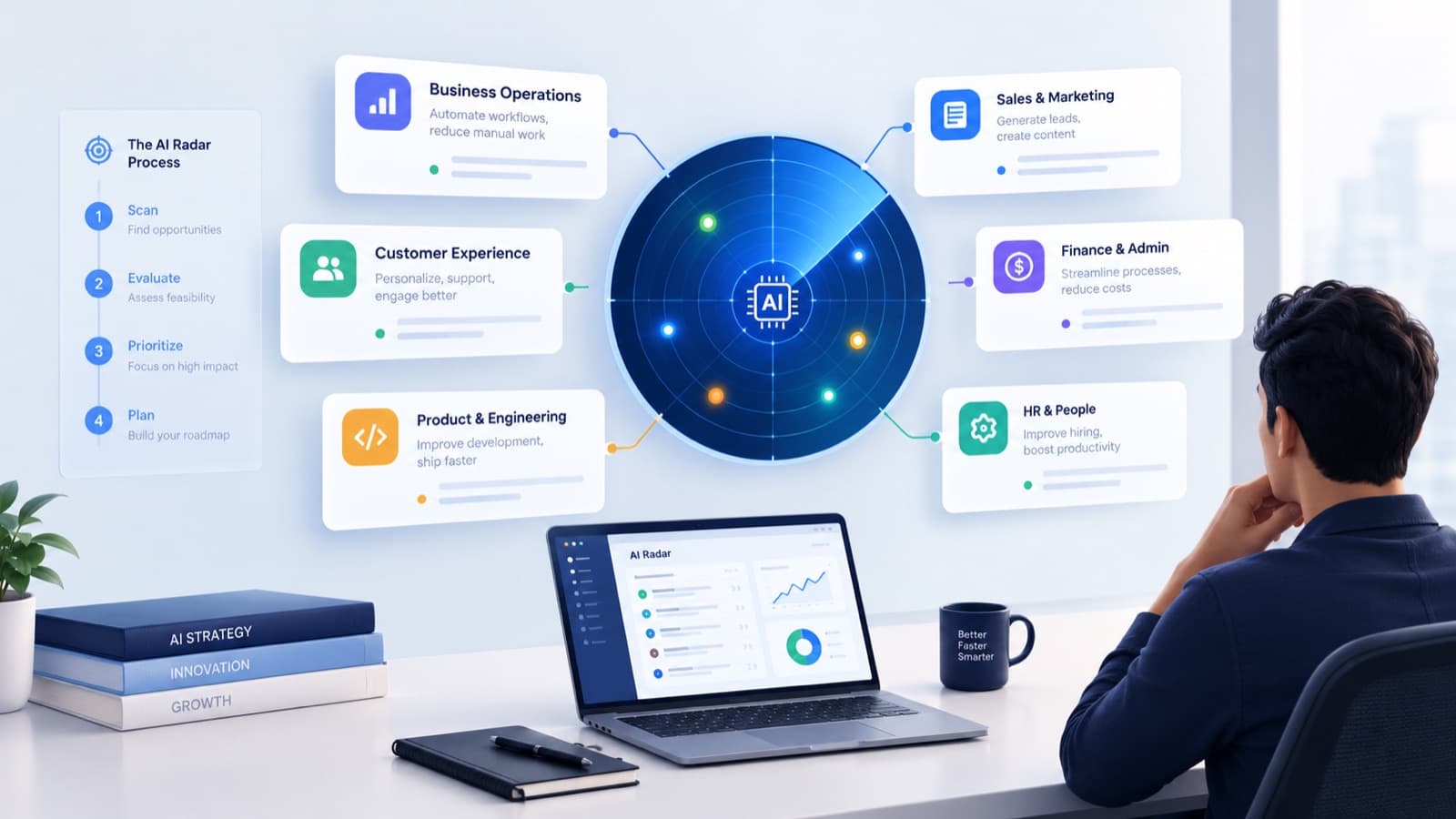
Every week we read the launches, filings and changelogs so you don't have to. We check each story against its official source. Then we explain what it means for a business deciding where AI fits.
This issue covers 23 to 30 October 2026.
The Short Version
- Agents that click through software got cheaper. OpenAI's new GPT-6.1 Terra costs $1 per million input tokens.
- Google's strongest model arrives with a price rise built in. Gemini 4 Carbon's price doubles after an introductory period.
- Voice AI is consolidating. Deepgram is buying Daily, the company behind the open-source Pipecat toolkit.
- You can now run a top-tier model on your own servers. Mistral released the weights of Mistral Large 4.
- Spending caps are becoming standard. GitHub added per-run and per-month AI credit limits to Copilot Automations.
- New York set rules for chatbots that minors can reach. Fines reach $25,000 per violation.
OpenAI's GPT-6.1 Terra Makes Computer-Use Agents Cheaper
What happened. On 26 October, OpenAI released GPT-6.1 Terra (opens in a new tab), a fast model built to read screens and take actions across apps. OpenAI lists it at $1 per million input tokens, $0.05 for cached input and $5 for output. Batch and Flex processing cost 50% less.
OpenAI says Terra "matches GPT-6 Astra at one-tenth the price per token." It also claims Terra finishes tasks "over 3× faster on average" than both Astra and GPT-6.1 Sol. Those figures come from OpenAI, not independent tests.
What it means for you. Many businesses run on software with no API: supplier portals, old ERPs and government forms. An agent that operates the screen like a person can now work inside those tools at a lower cost per task. Test it on your own workflows first. The speed figures come from OpenAI's tests, so measure on your own portals before you rely on them.
Google's Gemini 4 Carbon Leads, With a Price Rise Already Announced
What happened. On 28 October, Google announced Gemini 4 Carbon (opens in a new tab) as its strongest model. Google says it ranks first on the Artificial Analysis Intelligence Index v5.0, with a score of 59.
For now, only a small group of security teams can use it. Google promises wider access "as soon as possible," with no date. Launch pricing is $2 per million input tokens and $10 per million output tokens. After an introductory period with no stated end, the price rises to $4 and $20.
What it means for you. Budget on the later price, not the launch price. Also build so you can switch model providers. The top spot on these leaderboards keeps changing, and so do prices.
Deepgram Is Buying Daily, the Company Behind Pipecat
What happened. On 29 October, speech recognition company Deepgram announced it is acquiring Daily (opens in a new tab). Daily makes Pipecat, a widely used open-source toolkit for building voice agents. Pipecat stays free under its current license, and an independent Pipecat Foundation will look after it.
Deepgram did not disclose the price, and the deal has not closed yet. Deepgram says it serves "more than 5,000 organizations." It also previewed a combined Voice Agent Platform. TechCrunch has more detail (opens in a new tab).
What it means for you. The voice agent market is narrowing to a few full-stack platforms. Phone agents built on open tooling stay portable if a vendor raises prices or changes direction. Ask any voice AI partner which parts of your agent you could move elsewhere.
Mistral Releases a Trillion-Parameter Model You Can Host Yourself
What happened. On 29 October, Mistral published the weights of Mistral Large 4 (opens in a new tab), so companies can download it and run it on their own servers. The license is a modified MIT license. Commercial use is allowed, but companies that resell it as a hosted model service need a separate licence.
If you use Mistral's own hosted version instead, it costs $0.70 per million input tokens, $0.07 for cached input and $2.10 for output.
What it means for you. If your data can't go to a US provider, you now have a top-tier option you can keep in-house. That covers many teams in finance, health and government, and anyone with data-residency rules in India or the EU. A model this size needs data-centre GPUs to run. Most small teams will still use it through an API.
GitHub Adds Spending Caps to Copilot Automations
What happened. On 28 October, GitHub expanded Copilot Automations (opens in a new tab). These are AI workflows that start from events, schedules or tools like Jira and PagerDuty. You can now set AI credit limits per run, day, week or month.
GitHub Agentic Workflows, which run AI agents inside your build and deploy pipelines, is now available on the Free, Team and Enterprise plans. A Copilot Standalone plan costs $10 per user per month, billed from the first request.
What it means for you. Hard spending caps are now a normal feature. Ask for them in every AI tool you buy or build, with a cap on each run as well as each month.
New York Sets Rules for Chatbots That Minors Can Reach
What happened. On 28 October, Governor Hochul signed bill S.9051B/A.10379C (opens in a new tab). It bars chatbot features that are unsafe for minors. Examples include a bot claiming to be a real person or to have emotions, or encouraging secrecy or self-harm.
Companies must verify age and offer more than one way to do it, including one that doesn't rely only on a government ID. The attorney general can seek "civil penalties of up to $25,000 per violation." The rules take effect "in the coming months," with no exact date yet.
What it means for you. Review any consumer-facing chatbot or voice agent that people in New York can reach. Check how it confirms age and whether its persona claims to be human. Our voice agents say they are AI at the start of every call, and we recommend that for every bot.
Anthropic's IPO Filing Shows Businesses Paying for AI at Scale
What happened. On 26 October, Anthropic, the maker of Claude, publicly filed to list on Nasdaq (opens in a new tab) under the ticker "ANT."
Coverage of the filing reports first-half 2026 revenue of $16.29 billion, up from $1.16 billion a year earlier. It also reports more than 11,900 customers paying over $100,000 a year, up from more than 950. About 80% of revenue comes from usage-based API spend. These figures are reported: we took them from Yahoo Finance's coverage (opens in a new tab) and have not checked them in the filing itself.
What it means for you. Businesses are paying for AI in production now, beyond pilots. If your team still treats AI spend as an experiment, competitors may already run it every day.
What We're Watching
- Alphabet's quarterly results (28 October). Google says the Gemini app has one billion users, and that Cloud revenue grew 103%.
- Block's Dessa voice model. It listens and talks at the same time and runs on a high-end laptop. It's a research preview with no public access yet.
One Thing to Do This Week
Pick one AI tool your team already pays for. Find out whether it has a spending cap per task and per month. If it doesn't, set a billing alert today, so a runaway agent can't surprise you at the end of the month.